Branded Residences & Mixed-Use
Hospitality now earns beyond the room: branded residences, workspaces, wellness, retail and events. We plan mixed-use projects where every component strengthens the others instead of competing with them.
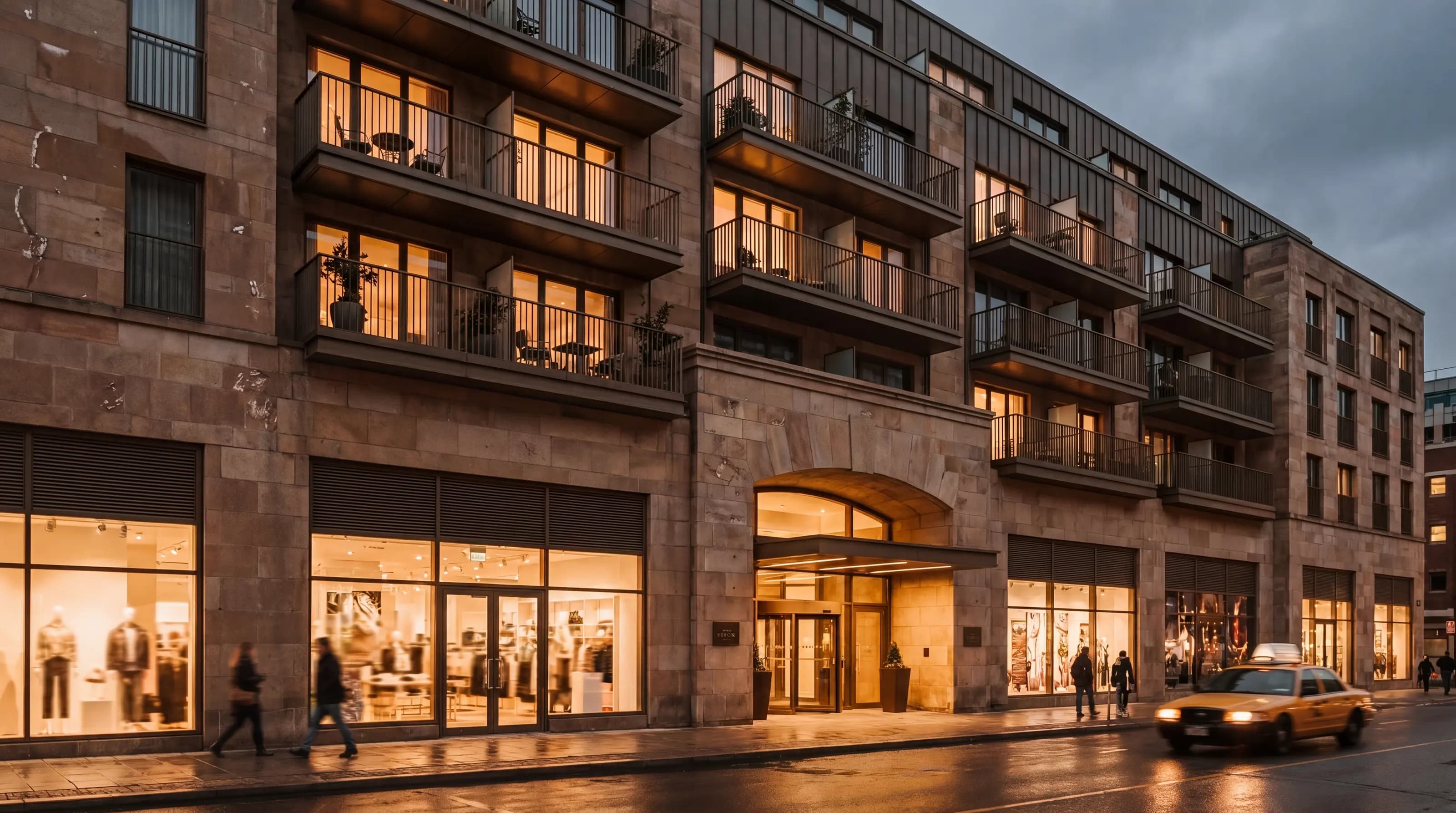
How do several uses share one infrastructure without destroying value?
One building, several economies · illustrative
An illustrative mixed-use building section: residences, hotel, amenities and retail stacked in one envelope, sharing arrival, one vertical core, plant and back of house, and loading. For every shared system: who uses it, who controls it, who pays for it.
One address
From the street it is one building. On the balance sheet it is several businesses.
Several economies
Residences sell once. Hotel keys sell every night. Retail pays rent. Each floor answers to a different profit and loss statement.
One shared body
They stand on the same arrival, the same core, the same plant, the same loading dock. None of these earns anything; all of them serve everything.
The allocation
For every shared system, three questions are settled before the first resident moves in: who uses it, who controls it, who pays for it.
The allocation decides whether the synergy is real, or a subsidy.
NMBR Section no. 01 · Mixed use
Mixed-use is where one-dimensional thinking costs the most. A residential tower and a hotel sharing a podium are not two projects stapled together; they share arrival, services, staffing and a brand promise. Done well, each raises the value of the other. Done carelessly, the operating hotel subsidizes everyone else’s promises.
We model the whole: the licensing economics of branded residences, the service agreements between components, the shared-cost allocations that later govern every dispute, and the operational reality of one staff serving several businesses under one roof.
What this work covers
- Branded-residence strategy, economics and brand licensing
- Mixed-use programming across hotel, residential and commercial
- Shared services and cost-allocation structures
- Revenue modelling of every physical component
- Owner-side coordination among component stakeholders
Feasibility & Business Planning
Before a hotel is drawn, it is decided. We test what the land, the rights and the market can actually carry, and build the business plan an owner can take to a board or a bank.
Hotel Programming
The hotel program is where business plan becomes building: every square meter assigned a job, every flow walked in advance, every operational consequence priced before it is poured in concrete.